

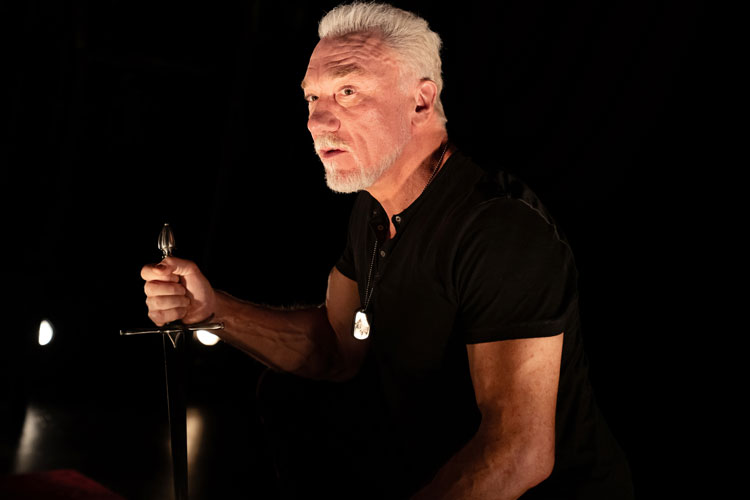
Dubbed “The villain of Broadway” by Playbill, Patrick Page has never shied away from exploring his dark side. Now, with his tour-de-force solo show, All the Devils are Here, he turns his attention to the twisted motivation and hidden humanity at the heart of Shakespeare’s greatest villains. Created and performed by Page, the Octopus Theatricals production is directed by Simon Godwin. The duo brings the fullness of Shakespeare to life in this dynamic, contemporary, and accessible take on The Bard’s villains, giving an evening of mesmerizing artistry and powerful storytelling, delivered with rare intimacy that will redefine your perception of Shakespeare and his villains.
Moving swiftly through the Shakespeare canon of villains in chronological order, Page illuminates the playwright’s ever-evolving conception of evil by delving into more than a dozen of his most wicked creations. Thrilling, biting, hilarious, and enlightening, what Page delivers is a masterclass on the most terrifying subject of them all: human nature. And along the way, he shares examples of how each character’s evil nature continues to influence characters in film, TV, and streaming entertainment.
Staged on Arnulfo Maldonado’s scenic design which incorporates Stacey Derosier’s lighting design (most often blood red) on three sides of Page’s performance space, the show begins with Page discussing where Shakespeare came up with the concept of showing the overall humanity behind the evilest of human characters. It all began at age 8 in 1572 when young Will experienced his first traveling company of morality players. One of those masked characters was known as The Vice who personalities all the sins of humanity. Page brings that character to life in a half-face red mask, accentuating his lines with a red tambourine. But, like in Greek tragedies, that evil character has no soul – no humanity – just portrays the embodiment of pure evil, often at the expense of the disabled, or racial and religious minorities, persons accepted as less than human at the time.
Page then compared The Vice to Shakespeare’s first truly evil character, Richard III, who was disabled and cared little for how his actions affected others – perhaps a true sociopath, as were most of Shakespeare’s villains. But what he added into these evil characters was how sexy their badness can be. This is also true for Aaron the Moor in Titus Andronicus, the ogre who took the stage next prior to all theaters being closed for two years due to the plague. Sound familiar? During those two years, Shakespeare fell in love with a dark-haired woman who inspired him to write about love for years. But prior to that time, lovely blonde women were the leading ladies of love, a tradition blasted apart by The Bard.
In 1596, it was time to get back to the evil in men’s souls with the creation of Shylock in The Merchant of Venice. But what is the most interesting question about this immoral character who asks for a pound of flesh is how his brutal actions had audiences thinking about the reasoning behind Shylock’s actions, making them sympathetic to what they would have done had they been forced to face how that character’s evil deeds were based on revenge for the way society had treated him, simply because he was a Jew. Page delivers a monologue from the play which shows the character’s universal humanity appealing his case in court, as opposed to his evil need for revenge.
The title character Hamletis perhaps the best-known of The Bard’s villains, ending with the bloodbath needed to cleanse the villains from the Daniel court. Page delivers his soliloquy in the chapel prior to Hamlet deciding to kill his stepfather, sharing not only his words but also his jumbled thoughts, thus giving the audience a true look at the troubled mind leading to this villain’s inability to take action against perceived wrongdoings.
Measure for Measure examines the evil nature of lust, which Page morphs into perhaps the most evil of sociopaths in any of his plays – Iago in Othello – which shows how evil can be hidden in plain sight all around us. Page delivers the scene between Othello and Iago, beginning showing their mutual respect and friendship which winds up convincing the gullible Othello that his pure and lovely wife is cheating on him. Fueled by both men’s “green-eyed monster” jealousy and lack of conscience, Iago demonstrates no shame and no internal restraint in his actions, reminding the audience to not just listen to words but look to the actions of others to understand who they really are. At that point, Page took out a checklist of characteristics of sociopaths, asking us to look into those in our own lives to see if anyone fits into that category.
Page goes on to examine King Lear, Macbeth and his murderous wife with the addition of stage fog to add to the atmosphere of evil added into the tale by the three Witches. In fact, Page makes sure to remind everyone to not mention the name of the play (call it “The Scottish Play”) when inside a theater and how to counteract what evil may come from doing so. Lastly, it’s on to Prospero, the evil and revengeful wizard in charge of his island in The Tempest whose power creates the most violent of storms to bring his enemy to him. Sound design by Darron L. West adds in realistic thunder and lighting to this most powerful portrayal of Shakespeare’s last villain, complete with his floor-stomping wooden staff. So overpowering is Page’s stage presence, I now wish to see him portray all the villains in each of these plays, his booming voice perfectly in tune with the many sides of each complicated character.
Running through January 25 at BroadStage, 1310 11th Street in Santa Monica, I urge you to grab tickets to see Patrick Page in All the Devils are Here at https://broadstage.org/tickets-shows/calendar/all-the-devils-are-here/ or by calling the box office at 310-434-3200. The performance runs approximately 1 hour and 25 minutes with no intermission. Following each performance, the audience is invited to a 15 to 20-minute talkback with Patrick Page to explore the world of Shakespeare’s villains and his relationship to them more intimately. Be sure to stay for this insightful look into his thoughts about the show, his history with The Bard, his personal experience becoming Shakespeare’s villains throughout his career, and why he believes those villains are some of the best roles for actors as they age and gain more insight into the human psyche.