

By Devon C, age 14
KidScoop Media Correspondent
Location: Moss Theater at New Roads School
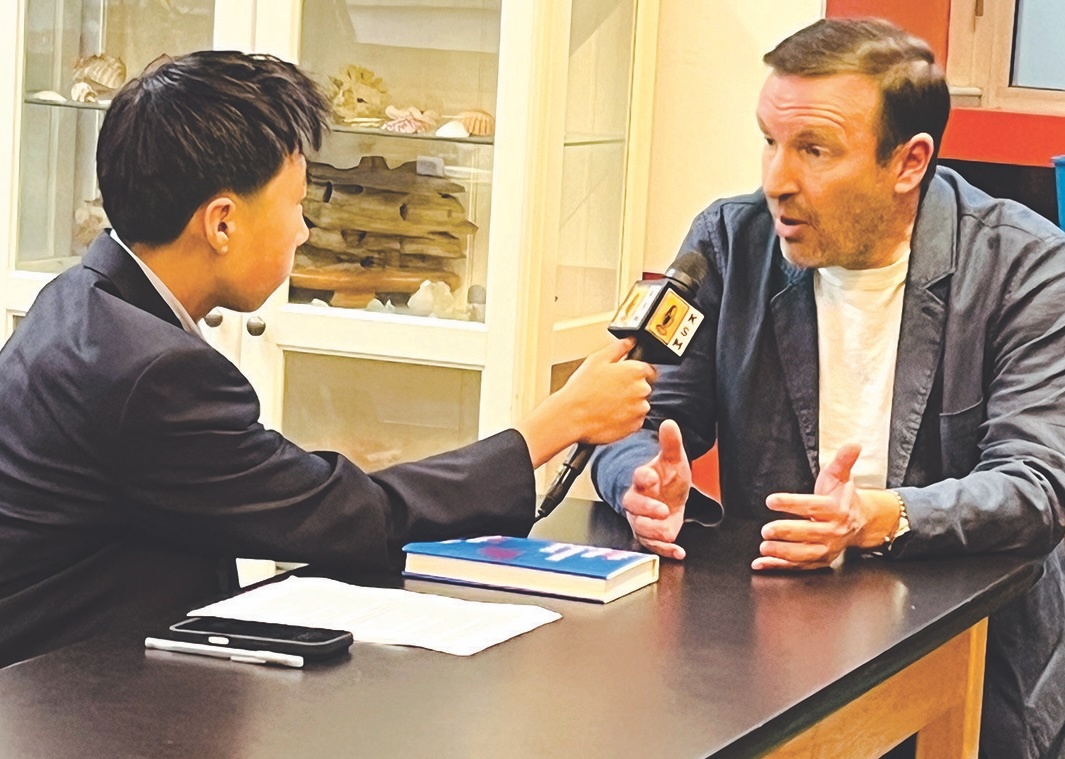
I traveled to New Roads School in Santa Monica with Kid Scoop Media to interview U.S. Sen. Chris Murphy of Connecticut on his new book, The Crisis of the Common Good: The Fight for Meaning and Connection in a Broken America.
Sen. Murphy was on his book tour, so the first thing I asked him was why he wrote the book. He responded: “This is a book about why this country ended up with somebody like Donald Trump [as President] … This book makes the argument that what makes us really happy is feeling like we belong, feeling like we’re part of a community, and engaging in projects to make our community better.” I agree with Sen. Murphy; it’s a book about the conditions that left people feeling so disconnected that someone who promised disruption felt like the right answer. Social media and profit-hungry corporations have taken the focus of our attention, rather than connecting with our friends, family, and community.
When I was reading Sen. Murphy’s book, I noted that he has an 8th-grade son who plays hockey, which reminded me of my own love for swimming. In his book, Sen. Murphy writes about how, although attending his son’s games are a highlight for him and his family, parents can no longer film their own kids’ games. Instead, if they want to watch a video of the game, they have to pay a hefty subscription fee to Black Bear TV, the company that runs the Junior Hockey League. In his book, Sen. Murphy writes that because “…greed consumed the [Black Bear TV] executives,…they banned parents from streaming games for grandparents or the parent who didn’t drive two hours…, forcing families into their subscription service.” Instead, parents, grandparents, or friends now have to pay $25 to $50 a month in order to stream the game. I asked him how Americans can address this concern, and he responded: “I think there should be parts of our economy that are not run just for profits … It makes people feel really empty when everything in their life is a commodity, when everything is run for the primary purpose of profit.” As a frequent volunteer for non-profit organizations, I can connect with his vision of communities where the drive is focused on helping others and not money.
This reminded me of his annual walk across Connecticut, where he crosses the entire state, listening to his constituents along the way. The entire journey takes him seven days! I asked him what the walk meant to him: he described the walk as a discovery of what the people of Connecticut truly care about: “I just want to make sure that I don’t come to believe that the issues that are getting the most clicks online are the issues that really matter to people. The topic of the day changes all the time, but the issues that matter to the people I meet on the walk never change.” I asked what the most important lesson he learned was. He described a man named Izzy that he also wrote about in his book. Izzy had been a longtime employee at Walmart, but was still only making minimum wage. Sen. Murphy relayed Izzy’s perspective on the world: “[Izzy] watches people in this country become trillion-aires. He watches people worrying about how much their sixth home is going to cost, and he just feels like there’s a fundamental unfairness for people like him.” I agree with him: Large, well-known, and profitable American companies aren’t paying people enough to live above the poverty line; they are letting people, while still working a full-time job, sit in despair. America was known as the land of opportunity, but many Americans are quite familiar with Izzy’s experience and sentiment.
I asked Sen. Murphy how Americans could bring back the feeling of community in a big city like Los Angeles. He suggested, “Well, you probably know which stores in your neighborhood are owned locally and which are the big chain stores. We can all make a choice to support local commerce.” On that note, I asked Sen.Murphy what his favorite restaurants are in Wethersfield, Connecticut, where he grew up. His eyes lit up, and he described an old pizza joint called Vito’s Pizzeria. He said that as a kid, his family would go to the restaurant every Sunday night. Still to this day, his father picks up a pizza every Sunday night and spends 15 minutes talking with the owner, an experience you can only get at a local restaurant.
Interviewing Sen. Murphy was an experience I will never forget. Hearing from a current congressman about how we, as Americans, need to join together and support local businesses makes me optimistic about the future.